AI Visibility · Local SEO · GEO
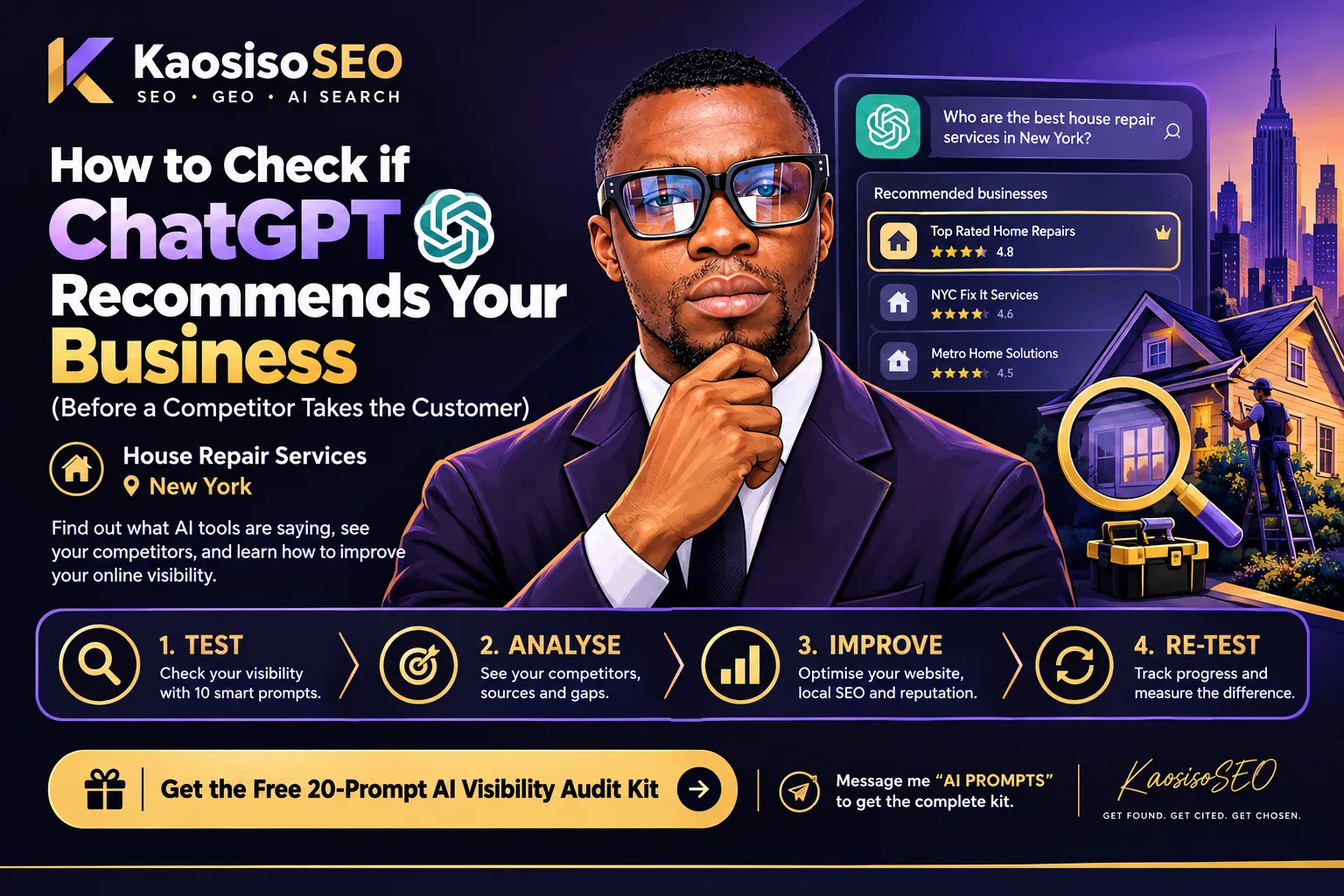
How to Check if ChatGPT Recommends Your Business (Before a Competitor Takes the Customer)
By Kaosiso Ezebuenyi · October 2026 · About 5 minutes
Picture a customer in New York who needs house repair services. They open ChatGPT and ask, “Who are the best house repair service providers in New York?”
ChatGPT suggests a few businesses. The customer checks their options and decides whom to contact. Is your business on that list?
Many business owners track Google rankings, website traffic and social media engagement. But they may not know whether AI tools mention their business when potential customers ask for recommendations. Here is how to check, identify competitors and understand what to improve.
Why AI recommendations deserve your attention
BrightLocal’s 2026 Local Consumer Review Survey reported that 45% of surveyed US consumers had used generative AI tools for local business recommendations. SOCi’s 2026 Local Visibility Index examined AI visibility across locations associated with multi-location brands and reported differences between platforms.
These findings suggest that AI-assisted discovery deserves attention. They do not mean every customer uses AI or that every small business is losing customers to competitors. The practical question is: when someone asks an AI tool for a business like yours, what does it say?
Research: BrightLocal Local Consumer Review Survey and SOCi research. Check the original reports for the exact methodology and findings before citing individual figures.
1. Test whether ChatGPT recommends your business
Start with ChatGPT, then repeat the process with Gemini, Perplexity and Google’s AI search features. Open a fresh conversation and record the date, platform, location and available search settings. A fresh conversation reduces the influence of earlier messages but does not guarantee a completely independent result.
Try these example prompts, replacing the brackets with your details:
- Brand accuracy: “What is [Business Name], and what house repair services does it provide?”
- Local discovery: “Who are the best house repair service providers in New York?”
- Customer need: “I need help repairing damaged walls and ceilings in New York. Which businesses should I consider?”
For a useful baseline, test 10 prompts covering brand accuracy, local discovery, competitors and customer needs. Run each once for an initial snapshot; repeat them three times when you want to observe variation. Request the complete 20-prompt kit below for a more extensive audit.
2. Record what the AI says
Track five things: whether your business is mentioned, whether it is actively recommended, whether its details are accurate, which competitors recur, and which sources the answer links to. Save the prompts, dates and screenshots where possible.
A prompt that names your business tests brand recognition or competitive positioning; it does not establish independent discovery. Use prompts that do not name your business to assess whether it appears without being suggested by the question. A citation is a clue about a particular answer, not proof of a universal trust signal.
3. Turn findings into improvements
| What you notice | What to investigate |
|---|---|
| Your business rarely appears for local discovery prompts | Clarify your service pages, service areas and customer-focused content. |
| AI gives incorrect business details | Check your website, business profiles and relevant directories for inconsistencies. |
| Competitors appear repeatedly | Compare their service pages, reviews, listings and relevant third-party coverage. |
| AI cites directories where you are absent | Check whether those directories are reputable, relevant and appropriate for your business. |
| Results differ by platform | Compare prompts, settings and sources before deciding what to change. |
These are diagnostic starting points, not proof of what caused a particular answer.
4. Improve the foundations of AI visibility
- Make your website specific. Explain what you do, where you operate, whom you serve and which customer problems you solve.
- Strengthen your local presence. Maintain an accurate Google Business Profile if eligible, consistent business information and relevant local pages.
- Build a credible reputation. Encourage genuine reviews, respond professionally and keep listings accurate. Never buy fake reviews.
- Check technical accessibility. Ensure important pages can be crawled and indexed where appropriate, work well on mobile and load reliably. Use structured data that accurately describes visible page content; it does not guarantee AI recommendations.
- Review third-party sources. If the same directories or industry websites recur in your tests, check whether they accurately represent your business and offer a legitimate opportunity to improve your presence.
5. Measure progress
Save your initial results as a baseline. After making meaningful improvements, repeat the same prompts under comparable conditions. Compare mentions, accuracy, recurring competitors and cited sources. Google Analytics 4 can help monitor visits from AI referral sources, although referral tracking will not capture every AI-assisted visit. Do not react to one missing recommendation; look for patterns across repeated tests.
Free resource
Want the complete 20-prompt AI visibility audit kit?
The full kit expands testing across brand accuracy, category discovery, competitor comparisons and customer needs. Message “AI PROMPTS” to request the free kit and a simple scorecard for recording your findings.
Request the prompt kitNeed help interpreting results and prioritising improvements? Explore our SEO and AI visibility services.
About the author
Kaosiso Ezebuenyi works in SEO, Local SEO and generative engine optimisation (GEO), helping businesses improve their discoverability across traditional search engines and AI-powered search experiences.